Section Thursday, Jan 15

This is an outline of the topics we covered in class. These notes are not a substitute for your own note-taking. I highly recommend that you take your own notes during class. If you ever miss a class for any reason, reach out to another student in class to get a copy of their notes.

Subsection Sec 1.3: Conditional Probability

Question: How does evidence (e.g., knowledge of one event occurring) change our knowledge of probabilities for other events?

Example 22.

Roll a fair D6 two times. Let \(A = \{\text{sum } \geq 10\}\) and \(B = \{\text{first roll is } 6\}\text{.}\) \(A\) feels more likely if we already know \(B\) has occurred.

Definition 23.

The conditional probability of \(A\) given \(B\) is: ,
\begin{gather*} \Pr(A \mid B) = \frac{\Pr(A\cap B)}{\Pr(B)} \end{gather*}
described in detail following the image
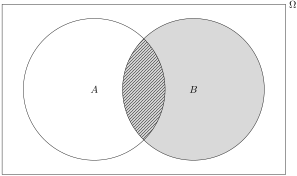
Two overlapping circles representing events \(A\) and \(B\) sit inside a rectangle representing the sample space \(\Omega\text{.}\) The circle labeled \(B\) is shaded. The portion of that circle which is overlapped by the \(A\) circle is also filled in with slanted lines.
Figure 24. \(\Pr(A \mid B)\) tells the proportion of \(B\) which is overlapped by \(A\text{.}\)

Example 25.

Continuing from the previous example, \(|\Omega| = 36\text{.}\)
\begin{align*} A \amp = \{(4, 6), (5, 5), (5, 6), (6, 4), (6, 5), (6, 6)\} \\ B \amp = \{(6, 1), (6, 2), (6, 3), (6, 4), (6, 5), (6, 6)\} \\ A \cap B \amp = \{(6, 4), (6, 5), (6, 6)\} \end{align*}
So \(\Pr(A) = \frac{6}{36}, \Pr(B) = \frac{6}{36}, \text{and } \Pr(A\cap B) = \frac{3}{36}\text{.}\) Then:
\begin{gather*} \Pr(A \mid B) = \frac{\Pr(A\cap B)}{\Pr(B)} = \frac{3/36}{6/36} = \frac{3}{6} = \frac{1}{2}. \end{gather*}
Notice that \(\Pr(A\mid B)\) is significantly larger than \(\Pr(A)\text{.}\)
Subsection Diagnostic Testing

Setup: A patient takes a diagnostic test. Let \(P\) be the event that they test positive. Let \(D\) be the event that they have the disease.

Definition 26.

The sensitivity of a diagnostic test is \(\Pr(P \mid D)\text{.}\) The specificity of a diagnostic test is \(\Pr(P^c \mid D^c)\text{.}\)
But, what the patient really wants to know is \(\Pr(D \mid P)\text{.}\)

Example 27.

A disease has a prevalence of 1%. A test has sensitivity of 90% and specificity of 91%. For a patient who gets a positive test result, what is the probability that they have the disease?
\begin{align*} \text{A) } 9/10 \amp \amp \text{B) } 8/10 \amp \amp \text{C) } 1/10 \amp \amp \text{D) } 1/100 \end{align*}
Answer.
For example, if a patient sees a positive diagnostic test result, they might try to calculate:
\begin{gather*} \Pr(D \mid P) = \frac{\Pr(P \mid D)\Pr(D)}{\Pr(P)} \end{gather*}
\(\Pr(P \mid D)\) is the sensitivity. \(\Pr(D)\) could be the prevalence. We don’t have direct access to \(\Pr(P)\text{.}\)
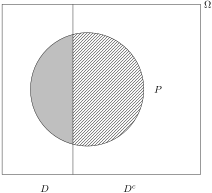
Observation: \(\Omega = D \cup D^c\text{,}\) so \(P = (P\cap D) \cup (P\cap D^c)\text{.}\)
Figure 29.
Observation 2:
\begin{align*} \Pr(P \mid D) \amp \frac{\Pr(P\cap D)}{\Pr(D)} \amp \amp \Rightarrow \amp \Pr(P \cap D) \amp = \Pr(P\mid D)\Pr(D) \\ \Pr(P \mid D^c) \amp \frac{\Pr(P\cap D^c)}{\Pr(D^c)} \amp \amp \Rightarrow \amp \Pr(P \cap D^c) \amp = \Pr(P\mid D^c)\Pr(D^c) \end{align*}
So:
\begin{gather*} \Pr(P) = \Pr(P\mid D)\Pr(D) + \Pr(P\mid D^c)\Pr(D^c) \end{gather*}

Example 31.

Continuing from the previous example:
\begin{align*} \Pr(D\mid P) \amp = \frac{\Pr(P\mid D)\Pr(D)}{\Pr(P\mid D)\Pr(D) + \Pr(P\mid D^c)\Pr(D^c)} \\ \amp = \frac{(0.9)(0.01)}{(0.9)(0.01) + (1 - 0.91)(1 - 0.01)} \\ \amp \approx 0.092 \end{align*}
What if the patient got a negative test result instead? In that case, what is the probaiblity they do not have the disease?
\begin{align*} \Pr(D^c\mid P^c) \amp = \frac{\Pr(P^c\mid D^c)\Pr(D^c)}{\Pr(P^c\mid D^c)\Pr(D^c) + \Pr(P^c\mid D)\Pr(D)} \\ \amp = \frac{(0.91)(1 - 0.01)}{(0.91)(1 - 0.01) + (1 - 0.9)(0.01)} \\ \amp \approx 0.999 \end{align*}

Subsection Sec 1.4: Independent Events

Question: \(\Pr(A \mid B)\) is supposed to capture how information about \(B\) affects the probability of \(A\text{.}\) What if it doesn’t?

Definition 32.

Events \(A, B\) are independent if \(\Pr(A \mid B) = \Pr(A)\text{.}\)
Observation: If \(A, B\) have nonzero probability and are independent, then:
\begin{align*} \Pr(A\mid B) \amp = \Pr(A) \\ \frac{\Pr(A\cap B)}{\Pr(B)} \amp = \Pr(A) \\ \Pr(A\cap B) \amp = \Pr(A)\Pr(B) \end{align*}
We can take this last equation as a definition of independence.

Example 33.

Continuing ExampleΒ 25, recall \(A = \{\text{sum} \geq 10\}\) and \(B = \{\text{1st roll is } 6\}\text{.}\) We found that \(\Pr(A \mid B) \neq \Pr(A)\text{,}\) so \(A\) and \(B\) are not independent.
Now consider the event \(C = \{\text{sum} = 7\}\text{.}\) We have:
\begin{align*} C \amp = \{(1, 6), (2, 5), (3, 4), (4, 3), (5, 2), (6, 1)\} \\ \Pr(C) \amp = \frac{6}{36} = \frac{1}{6} \\ B\cap C \amp = \{(6, 1)\} \\ \Pr(B\cap C) \amp = \frac{1}{36} \\ \text{therefore: } \Pr(C\mid B) \amp = \frac{\Pr(C\cap B)}{\Pr(B)} = \frac{1/36}{1/6} = \frac{1}{6} = \Pr(C) \end{align*}
Therefore events \(B, C\) are independent.